
Ancient Questions in a Modern Debate
The debate over artificial intelligence often assumes we are confronting entirely new questions. We are not. Long before computers and algorithms, people were already imagining intelligent machines and wrestling with many of the same questions that animate today’s AI debate.
My recent conversation with Dr. Elly Truitt, Janice and Julian Bers Professor of the History of Science at the University of Pennsylvania, reminded us that long before computers, algorithms, or large language models, societies were already imagining intelligent machines and asking what it would mean to live alongside them.
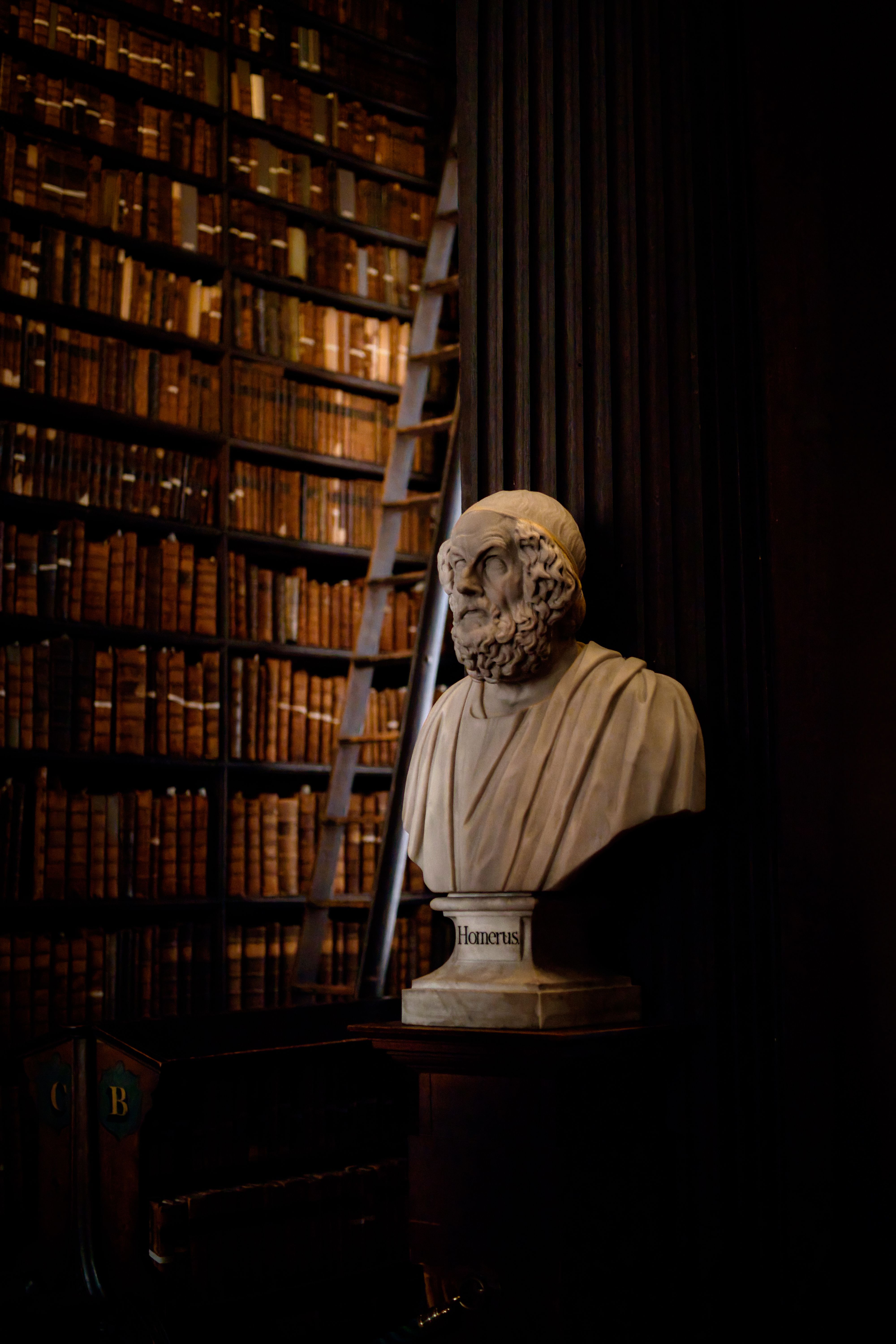
Homer’s Forgotten Vision of Technology
Christopher Nolan’s The Odyssey has renewed public interest in Homer’s epic, but much of the discussion has focused on Odysseus’ journey, the monsters, and the spectacle. Aside from Odysseus’ role in the construction of the wooden horse, not enough attention has been paid to Homer’s surprisingly sophisticated imagination of technology. The Odyssey and the Iliad before it introduce self-navigating ships able to move at the speed of thought, mechanical guardians that never sleep, and intelligent assistants capable of helping their creator.
The Phaeacian ships, a detail which Nolan excises entirely from his narrative, are particularly striking. Homer describes them as requiring neither pilot nor rudderman. They know their passengers' destination and navigate the sea on their own, making them sound remarkably like autonomous vehicles. What makes these ships, and the broader technological imagination surrounding the Phaeacians, so fascinating is not simply the technology itself, but the vision of society that accompanies it. Their autonomous technologies are not instruments of domination or coercion. They are integrated into a flourishing community where they facilitate human life rather than control it.
That makes the Phaeacian episode unusual. As some scholars have pointed out, much of Greek mythology, and many later stories of artificial beings, explore the breakdown of the relationship between humans and their creations once these technologies leave the realm of the gods. The bronze giant, Talos, ultimately falls. Pandora becomes an instrument of suffering. Later traditions revisit the same anxiety in stories such as the Golem of Prague and Mary Shelley's Frankenstein, where human creations exceed or escape their creators' control. Against that backdrop, the Phaeacians represent a rare alternative: a society in which advanced technology remains firmly oriented toward human flourishing.
That contrast speaks directly to today's AI debate. The central question is not simply whether increasingly capable AI systems can be built. It is whether societies can govern them in ways that advance human flourishing rather than reinforce coercion, inequality, or unchecked power. The Phaedrian episode suggests that the future of intelligent technology depends not only on the machines we create, but on the political, ethical, and institutional environment into which we introduce them.
Knowledge Wants to Travel
One of the interview's most striking themes was not simply the history of intelligent machines, but the history of how knowledge about them spread. As Truitt explains, ideas about automata did not remain confined to ancient Greece. They traveled east into the Buddhist world, where stories emerged of engineers journeying to the Greek-speaking world to acquire the secrets of automaton-making. Those ideas later flowed back through the Islamic world and Byzantium before reaching medieval Western Europe, where artisans transformed inherited concepts into increasingly sophisticated mechanical devices.
This history challenges a familiar assumption in today's AI debate: that technological leadership can be monopolized. Across civilizations, knowledge proved remarkably difficult to contain. It crossed political boundaries, languages, religions, and empires. Sometimes it spread through trade, sometimes through diplomacy, sometimes through translation, and sometimes, as the ancient stories themselves suggest, through outright technological espionage.
That historical experience offers an important perspective on contemporary debates over export controls, open versus closed AI models, and the global race for AI leadership. Governments and firms may succeed in slowing the diffusion of advanced capabilities, but history suggests that ideas themselves are extraordinarily resilient. The more enduring competitive advantage may therefore lie not simply in controlling knowledge but in cultivating the institutions, talent, and governance frameworks that allow societies to use that knowledge responsibly.
Technology, Power, and Human Relationships
Ancient and modern myths also reveal that intelligent machines were often imagined through a gendered lens of human relationships. Pandora, crafted by the gods as an engineered woman to punish humanity, embodies anxieties about technology as an instrument of control and deception. The stories of Pygmalion and, centuries later, Tristan and Isolde similarly explore the desire to create idealized, controllable companions, substituting artificial beings for the complexities of real human relationships. Rather than merely speculating about artificial life, these narratives expose enduring tensions surrounding power, dependence, gender, and the desire to shape human relationships through technology.
History offers a cautionary lesson. Across antiquity and much of the medieval world, intelligent machines were rarely created for the benefit of society at large. They served rulers, guarded palaces, reinforced political authority, displayed wealth, and projected power. As Truitt observes, technologies that further concentrate power in the hands of existing elites are difficult to describe as revolutionary, regardless of how technically impressive they may be.
That historical perspective should inform today's AI governance discussions. Public debate often revolves around what AI can do. History suggests we should be asking different questions: Who benefits from these systems? Whose interests do they serve? What forms of authority do they reinforce? And what responsibilities do creators owe, not only to their creations, but to future generations that will live with their consequences?
AI Has Always Been About Humanity
Perhaps the most important insight from Homer is that stories about intelligent machines have never really been stories about machines. They are stories about us: our desire for control, our anxieties about power, and our hopes for human flourishing. AI governance, therefore, is not simply about regulating algorithms. It is about deciding what kind of society we want intelligent technologies to help create.
Looking to Homer or the medieval world will not tell us how to regulate foundation models or autonomous weapons. History serves a different purpose. It reminds us that intelligent technologies have always shaped human relationships: between rulers and citizens, employers and workers, men and women, and creators and creations. They influence who exercises authority, who bears responsibility, and who benefits from innovation. Those are pre-eminently political, ethical, and social questions, and every generation must answer them anew.
The technologies change. The human questions do not. If anything, the enduring value of these ancient stories is that they encourage us to move beyond fascination with technological capability and toward a more fundamental inquiry: not simply what AI can do, but what kind of society we want AI to help build.
Editorial Note: In keeping with the AI Ethics and Governance Institute’s commitment to the responsible use of artificial intelligence, this commentary was drafted with AI assistance based on an Age of AI podcast interview conducted by the author with Dr. Elly Truitt. The analysis, structure, and final editorial decisions remain the responsibility of the author.